Theoretical Foundations
What is Sophiometry?
Sophiometry (from Greek σοφία, sophia, “wisdom” + μέτρον, metron, “measure”), is the science of measuring wisdom, a sub-discipline of psychometry, the science of measuring mental processes.
Psychometry faces the daunting task of translating psychological abstractions into reliable numbers, yet it has proven efficacy. For example, while there is no objective, material reference for what we mean by “intelligence”, specialists can nonetheless find enough common understanding to largely agree on assessments and applications. In fact, despite considerable (and justified) ongoing debate and complexity, “intelligence” assessments are the greatest success story of psychometrics, a discipline that is barely a century old.
Sophiometry faces all those challenges with much less maturity, yet similar opportunity for growth. Despite being a topic as old as writing, wisdom has only recently been subject to empirical, scientific examination, nicely summarized here. And despite a surge in published research over the last few decades, sophiometry is not a widely used term, something we hope to change!
The first challenge is understanding what we’re measuring . . .
How to define Wisdom?
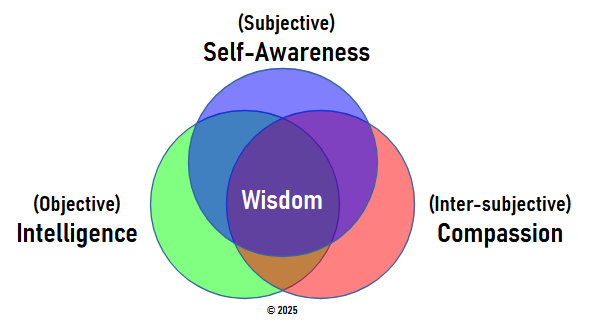
While there has always been some debate about what constitutes wisdom, researcher Monika Ardelt identified three core components: cognitive, compassionate, and reflective. This fits with the intuition that a wise person demonstrates cleverness (knowledge and problem-solving ability), kindness (compassionate concern for others), and calm self-awareness. Sophiometrics uses that tripartite (three-component) model, but with clearer distinctions for the dimensions.
“Knowing yourself is true wisdom.” – Lao Tzu
“Awareness of ignorance is the beginning of wisdom.” – Socrates
We take a targeted approach to extract the most valuable aspect of wisdom: self-awareness. The science of intelligence assessment is fairly advanced (and quite domain dependent), so we needn’t re-invent that wheel. Conceptions of moral, ethical, or compassionate traits are strongly influenced by cultural norms, so we avoid that quagmire. We believe that the crucial overlooked component of wisdom is self-awareness, which has been difficult to measure objectively. While our assessment overlaps somewhat with compassion and intelligence (as expected), it primarily captures a distinct, essential part of wisdom not otherwise obtained.
Please contact us to learn more about how this powerful model can help you build a wiser workplace.
Distinguishing Wisdom from Intelligence
In our modern, information-based culture, intelligence is visible and valuable. Yet, we see frequent examples of smart people doing stupid things. The intelligence to operate with external information is distinct from the wise skill to sense and leverage internal awareness. This distinction is fundamental to the theoretical, methodological, and analytical design of Sophiometrics assessments, allowing us isolate information ignored by other ability tests.
Extreme examples of intelligence without wisdom include the engineering hubris of the Titanic and the OceanGate submersible where very capable people created catastrophes. Similar but more insidious overconfidence appears in excessive medical treatments, judicial conviction of innocents, overrun construction budgets, and many other costly examples. Rarely are leaders praised for restraint. Even our education systems inhibit self-awareness by shaming innocent ignorance and encouraging students to guess at answers. A hallmark of wisdom is the ability to make unbiased decisions despite self-serving motivations, and this is what Sophiometrics measures.
As a counter-example, the fictional character Forrest Gump demonstrated wisdom, with associated humility, modesty, patience and kindness, despite low intelligence. Following his famous mantra, “Stupid is as stupid does”, Sophiometrics assesses wisdom by tracking what wisdom does, avoiding the multiple biases of self-report measures or subjective appraisals.
Consider the matrix below of competence and action contrasting our ability with how we apply it. The common action bias prioritizes the left column, which can lead to both “smart” and “stupid” outcomes. Ideally, we should prioritize the top row which accepts inaction as sometimes the wiser choice.
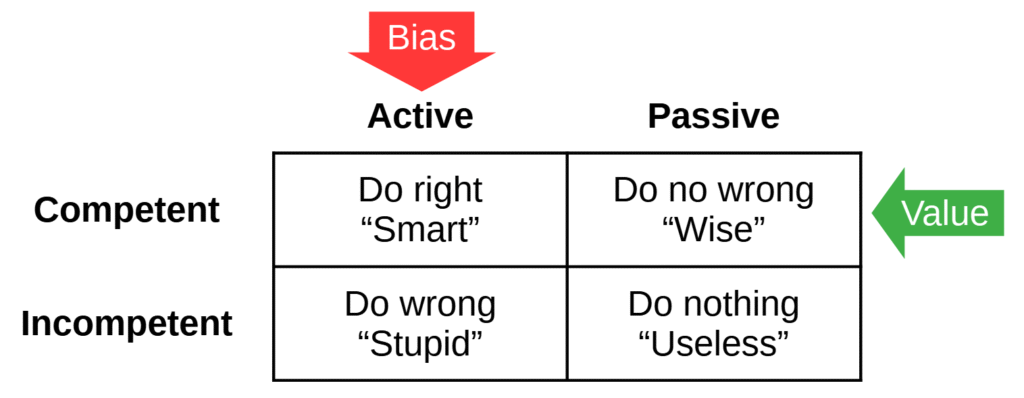
Faced with challenging problems, how do we decide between doing and not doing? Does pressure to perform push us toward failure? Sophiometrics captures the internal skill and awareness needed to make wise choices when they matter.
Don’t wait for decision risk to become decision damage.
Measure what’s missing. Build a wiser workforce.